A city can become so recognizable that people stop looking closely.
Miami arrives with a ready-made visual vocabulary: waterfronts, nightlife, expensive cars, bright clothes, and the promise of somewhere else to be tonight.
Those images belong to part of the city’s story. They cannot explain all the music made there.
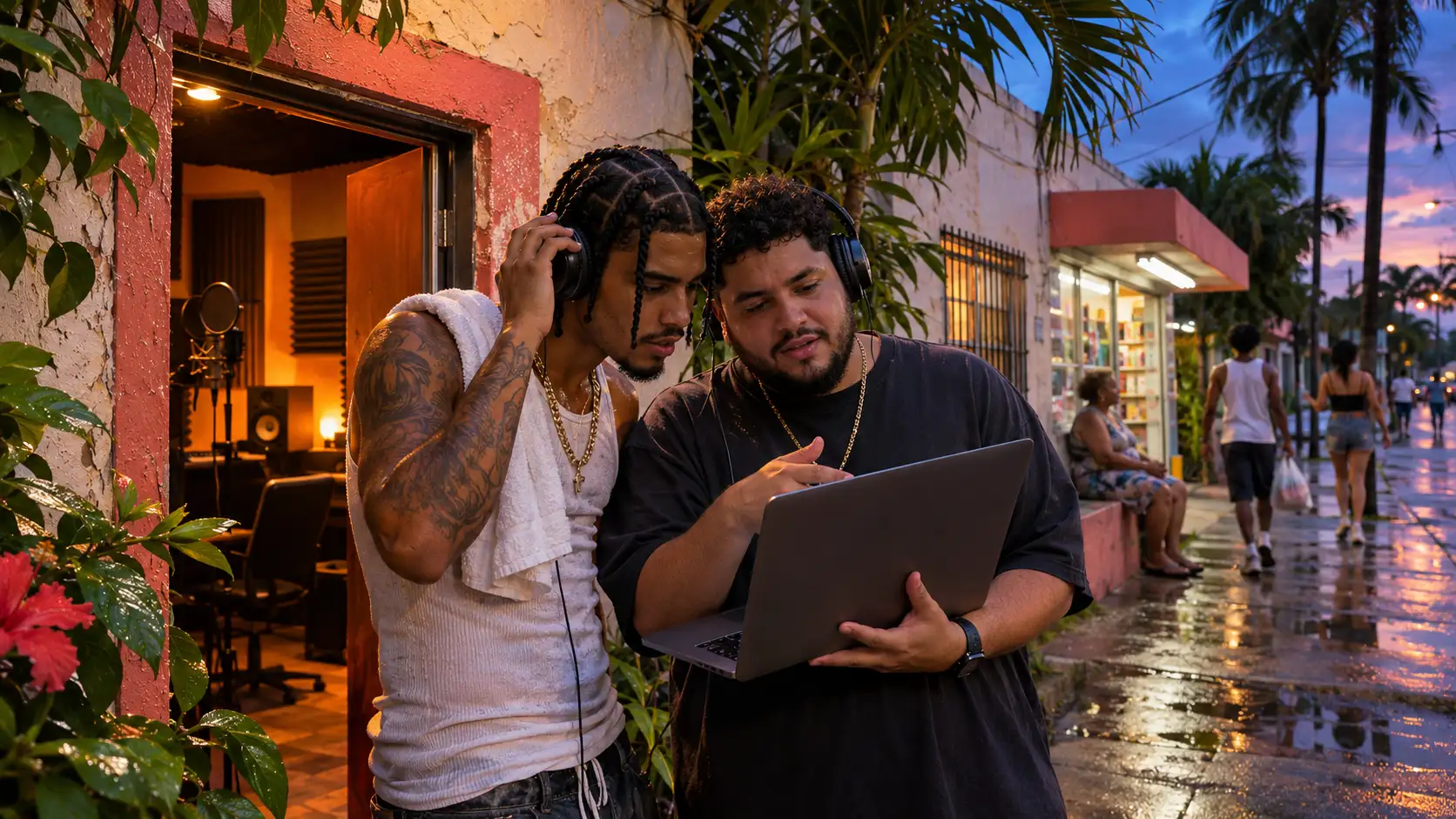
To hear Miami carefully, we need to follow the people whose work gives its neighborhoods a voice.
Then: A history with several directions
Miami New Times’ 2026 account of local hip-hop culture looks back through Miami bass, 2 Live Crew, Slip-N-Slide Records, Trick Daddy, Trina, Rick Ross, and DJ Khaled. It also discusses the later SoundCloud-era activity across South Florida.
The regional distinction matters.
South Florida is a useful frame for understanding connections, but it includes communities with their own histories. A Broward artist should not become a Miami artist simply because an outside publication wants a familiar label.
Listening starts with getting the place right.
Now: Begin with local discovery
Hy-Lo News’s October 2026 “305 On The Rise” class offers a current entry point into artists working across Miami-Dade and Broward.
Its selections include COOL SPITTA MOE, representing Little River and Little Haiti; Champolaa, representing Carol City; and Kyriq, representing Miami. Their submissions describe different creative priorities and connections to place.
That variety deserves attention. The value of a local discovery feature is not that it settles who represents a city. It gives listeners somewhere specific to begin.
The next step is to hear the work and allow those artists to be more than a geographic label.
Still building: Who connects the room?
Miami New Times’ 2026 recognition of Fat Jesu$ as Best Hip-Hop Act highlights production, collaborations, and advocacy for the local scene.
That is a useful reminder that influence may operate through connections.
A producer can help different voices find a shared audience. An organizer can create a bill that encourages listeners to arrive for one performer and discover three others. A visual creator can give a release a recognizable language without making every artist look the same.
These contributions help explain how a scene continues between its headline moments.
Next: Make discovery lead somewhere
For an emerging artist, being heard once is a beginning.
The practical question is whether a new listener can find the next show, understand the catalog, and stay connected between releases. A clear digital presence can support that relationship, but it needs work worth returning to.
Miami’s future should have room for music that reflects celebration, pressure, humor, experimentation, and ordinary life—without requiring every artist to perform the city’s commercial image.
The postcard can introduce a destination. The people making the music tell us why it matters.
Who is making Miami music that reveals something you would never learn from a travel advertisement?